Books on Film Camera History
A curated selection of essential reading on film cameras, photographic technology, and imaging history — from technical manuals to cultural histories.
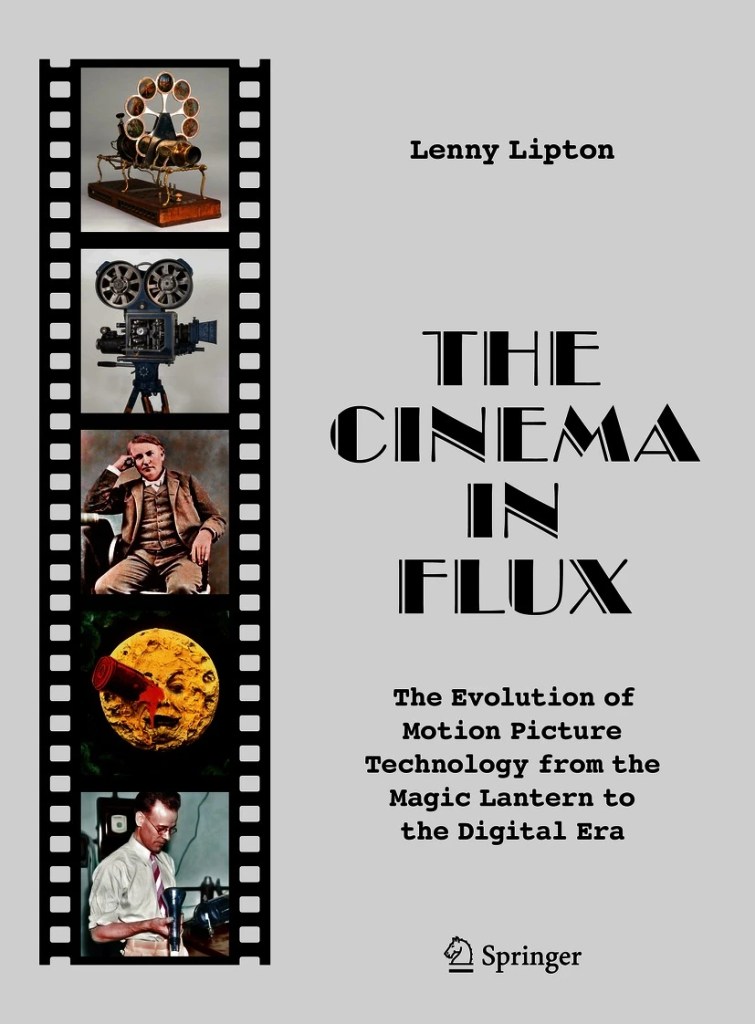
The Cinema in Flux
Lipton, L. (2021). The cinema in flux: The evolution of motion picture technology from the magic lantern to the digital era. Springer.
Annotation
Lenny Lipton’s The Cinema in Flux presents a comprehensive history of motion picture technology from the seventeenth-century magic lantern to contemporary digital cinema. Rather than focusing solely on filmmaking as an art form, the book examines the scientific, technical, and industrial innovations that made cinema possible, including the development of photography, film stock, cameras, projection systems, sound, color, widescreen formats, television, digital imaging, and stereoscopic (3-D) cinema. By tracing the evolution of these technologies in chronological order, Lipton demonstrates how scientific discovery, engineering, economics, patents, and artistic demands collectively shaped the modern film industry. This resource is especially valuable for undergraduate students and beginning researchers because it provides a detailed yet accessible overview of the technological foundations of filmmaking.
Lenny Lipton was an inventor, filmmaker, physicist, and pioneer of modern stereoscopic cinema technology whose work included the invention of RealD’s ZScreen projection system and more than 70 patents related to 3-D imaging. His extensive experience in both filmmaking and engineering makes him uniquely qualified to write on the history of motion picture technology. Published by Springer, the book is a scholarly resource that combines historical research with technical analysis. It is organized chronologically into major technological eras—including the Glass Cinema, Celluloid Cinema, Sound Cinema, Color Cinema, Television, and Digital Cinema—with numerous illustrations, references, bibliographies, and a detailed index that make it easy to navigate. While it is not a traditional encyclopedia, it functions as a comprehensive historical reference work and is appropriate for students, historians, film scholars, engineers, archivists, and professionals interested in the history of cinema technology.
Search Process
I found this book by searching my local library catalog using the keywords history of motion picture technology, cinema technology, and The Cinema in Flux.
Film Art: An Introduction
Citation
Bordwell, D., Thompson, K., & Smith, J. (2019). Film art: An introduction (12th ed.). McGraw-Hill.
Annotation
Film Art: An Introduction is one of the most widely used textbooks in film studies. It introduces readers to the principles of filmmaking, including cinematography, editing, mise-en-scène, sound, narrative structure, and film history. The textbook also traces the evolution of camera technology and filmmaking techniques from the earliest motion pictures to modern digital cinema. Because it provides both historical context and technical explanations, it serves as an excellent starting point for students researching the development of film and camera technology.
David Bordwell, Kristin Thompson, and Jeff Smith are internationally recognized film scholars whose work has shaped film studies for decades. The twelfth edition contains updated discussions of contemporary filmmaking while maintaining comprehensive historical coverage. The book is organized into clearly labeled chapters with numerous photographs, diagrams, sidebars, glossary material, references, and a detailed index, making information easy to locate. Although it functions primarily as a college textbook rather than a reference encyclopedia, it is one of the most authoritative introductory resources available. The intended audience includes undergraduate students, instructors, beginning researchers, and anyone studying film history or production.
Search Process
I located this book by searching in “all I-Share libraries” through the Rebecca Crown search bar, using the search terms film studies textbook, film history, and cinematography.
Cinematography: Theory and Practice
Citation
Brown, B. (2021). Cinematography: Theory and practice (4th ed.). Routledge.
Annotation
Blain Brown’s Cinematography: Theory and Practice is a comprehensive guide to the technical and artistic aspects of cinematography. The book explains camera operation, lenses, lighting, composition, exposure, movement, and visual storytelling while also discussing the transition from traditional film cameras to modern digital cinema systems. It is highly relevant to research on the evolution of filmmaking because it demonstrates how advances in camera technology have influenced the way films are produced. Undergraduate students, beginning filmmakers, and film enthusiasts would find this resource especially useful because it combines historical context with practical instruction.
Blain Brown is an award-winning cinematographer, director, and educator with decades of professional and teaching experience, making him a highly credible source. Published by Routledge, the book is widely used in university film programs. The fourth edition includes updated discussions of digital cinematography while preserving coverage of traditional film techniques. The content is organized into clearly labeled chapters with numerous photographs, diagrams, a glossary, bibliography, and a detailed index, making it easy to navigate. Although it is an instructional handbook rather than a traditional reference work, it provides extensive references for additional reading and research. The intended audience includes undergraduate and graduate students, cinematographers, film instructors, and independent filmmakers.
Search Process
I located this book by searching in “all I-Share libraries” through the Rebecca Crown search bar, using the keywords cinematography, camera technology, and film production.
Visit us
7900 W. Division Street, River Forest, IL 60305
Hours
Monday–Friday, responded daily
Phone
847-363-3543
 History of Film Cameras